
1.5 months ago
No. 48
[copy]
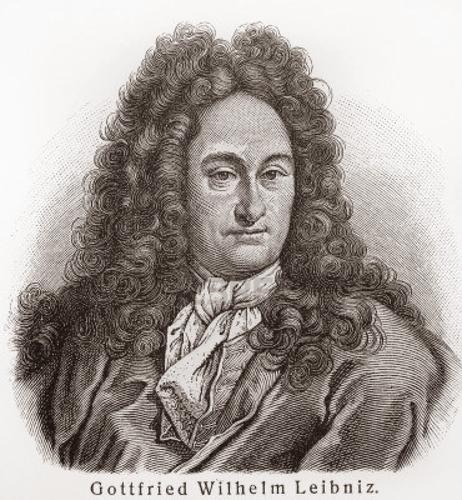
https://en.wikipedia.org/wiki/Gottfried_Wilhelm_Leibniz
Some things he did:
Mathematics
• Calculus — invented independently of Newton (cue the ugliest priority feud in academic history). His notation — dx, dy, the integral sign ∫ — is literally what you used in school. Newton's notation died a merciful death; Leibniz's won because it's actually usable.
• Binary number system — yes, THE binary. 0s and 1s. The dude was doing base-2 arithmetic in the late 1600s, partly inspired by the I Ching hexagrams (see below, this connects to something wild).
• Leibniz series for π — π/4 = 1 − 1/3 + 1/5 − 1/7 + ... Elegant, slow to converge, but iconic.
• Determinants — arguably before Cramer got credit for it.
• Combinatorics — wrote Dissertatio de Arte Combinatoria early in his career, foundational text.
• Topology — coined the term analysis situs, an early conceptual seed for what became topology.
Computing / Proto-CS
• The Stepped Reckoner — a mechanical calculator that could do addition, subtraction, multiplication, and division. Way ahead of Pascal's adding machine in ambition, though notoriously unreliable in practice (gear mechanism was a nightmare to manufacture with 17th century tooling).
• Characteristica Universalis — his dream of a universal symbolic language that could express all human thought unambiguously. Basically wanted to invent a formal logic notation for everything, 250 years before symbolic logic became a real discipline.
• Calculus Ratiocinator — a mechanical/algebraic system for reasoning itself. Feed in premises, crank the machine, get valid conclusions out. This is basically "let's automate logic" — conceptual grandfather of computation and AI. Norbert Wiener and other early computer scientists cited him directly.
• Binary + I Ching connection — he corresponded with Jesuit missionaries in China and got obsessed with the I Ching's hexagrams, seeing them as an ancient precedent for his binary system. Genuinely one of history's weirder East-meets-West nerd-sniping moments.
Philosophy
• Monadology — reality is made of "monads," indivisible, soul-like fundamental substances. Deeply weird metaphysics, still debated by philosophy nerds today.
• Principle of Sufficient Reason — nothing happens without a reason it's that way rather than some other way. Foundational for later rationalist and even scientific thinking.
• Identity of Indiscernibles ("Leibniz's Law") — if two things have all the same properties, they're literally the same thing. Still cited in philosophy of logic/identity debates.
• Best of All Possible Worlds — his theodicy, in response to the problem of evil. Got absolutely dragged for it by Voltaire in Candide (Dr. Pangloss is a direct parody of Leibniz). Brutal but funny.
• Pre-established harmony — mind and body don't interact, they're just synchronized like two clocks set to the same time by God. Sounds insane, was seriously argued.
Physics
• Vis viva — early concept of kinetic energy, launched a huge fight with Cartesian physicists over conservation laws.
• Relational space/time — argued against Newton's absolute space in the famous Leibniz-Clarke correspondence. This is basically an 18th century precursor to Machian/relativistic thinking about space.
The "surprising" tier
• Geology — wrote Protogaea, theorizing about Earth's formation, fossils, and geological history. Basically doing proto-earth-science before geology was a discipline.
• Psychology — concept of "petites perceptions," i.e. unconscious micro-perceptions below the threshold of awareness. This is a genuine precursor to the idea of the unconscious mind, way before Freud made it trendy/overused.
• Linguistics — studied comparative languages, theorized about proto-languages and how tracing language roots could reveal migration history of peoples. Kind of an early historical linguist.
• Legal theory — trained lawyer, worked on codifying and rationalizing legal systems, wrote on jurisprudence for the Holy Roman Empire.
• Political diplomacy — pitched plans for reunifying Catholic and Protestant churches (didn't work, obviously) and even floated ideas resembling a unified Europe centuries before the EU. Visionary or delusional depending on your cynicism level.
• History/genealogy day job — his actual paid position for most of his life was court historian for the House of Brunswick (Hanover). Wrote genealogies and dynastic histories. Imagine inventing calculus as a side project while your boss pays you to trace royal bloodlines.
• Mining engineering — designed windmill-powered drainage pump systems for silver mines in the Harz Mountains. Actual hands-on mechanical engineering, not just theory.
• Librarian — organized and ran ducal libraries, proposed early schemes for cataloging and organizing human knowledge (basically dreaming of a proto-Wikipedia/search-index for all books ever written).
The "questionable" tier
• Alchemy — was president of an alchemical society in Nuremberg. Historians go back and forth on whether he was a true believer, a skeptical opportunist networking with wealthy patrons, or genuinely hedging his bets between chemistry and mysticism (remember, chemistry and alchemy hadn't fully split yet).
• Perpetual motion musings — flirted with perpetual motion machine concepts, though he was smart enough to be skeptical rather than a true crank about it.
• Freemasonry rumors — unconfirmed, speculative, probably overblown by later conspiracy-brained historians.
Some things he did:
Mathematics
• Calculus — invented independently of Newton (cue the ugliest priority feud in academic history). His notation — dx, dy, the integral sign ∫ — is literally what you used in school. Newton's notation died a merciful death; Leibniz's won because it's actually usable.
• Binary number system — yes, THE binary. 0s and 1s. The dude was doing base-2 arithmetic in the late 1600s, partly inspired by the I Ching hexagrams (see below, this connects to something wild).
• Leibniz series for π — π/4 = 1 − 1/3 + 1/5 − 1/7 + ... Elegant, slow to converge, but iconic.
• Determinants — arguably before Cramer got credit for it.
• Combinatorics — wrote Dissertatio de Arte Combinatoria early in his career, foundational text.
• Topology — coined the term analysis situs, an early conceptual seed for what became topology.
Computing / Proto-CS
• The Stepped Reckoner — a mechanical calculator that could do addition, subtraction, multiplication, and division. Way ahead of Pascal's adding machine in ambition, though notoriously unreliable in practice (gear mechanism was a nightmare to manufacture with 17th century tooling).
• Characteristica Universalis — his dream of a universal symbolic language that could express all human thought unambiguously. Basically wanted to invent a formal logic notation for everything, 250 years before symbolic logic became a real discipline.
• Calculus Ratiocinator — a mechanical/algebraic system for reasoning itself. Feed in premises, crank the machine, get valid conclusions out. This is basically "let's automate logic" — conceptual grandfather of computation and AI. Norbert Wiener and other early computer scientists cited him directly.
• Binary + I Ching connection — he corresponded with Jesuit missionaries in China and got obsessed with the I Ching's hexagrams, seeing them as an ancient precedent for his binary system. Genuinely one of history's weirder East-meets-West nerd-sniping moments.
Philosophy
• Monadology — reality is made of "monads," indivisible, soul-like fundamental substances. Deeply weird metaphysics, still debated by philosophy nerds today.
• Principle of Sufficient Reason — nothing happens without a reason it's that way rather than some other way. Foundational for later rationalist and even scientific thinking.
• Identity of Indiscernibles ("Leibniz's Law") — if two things have all the same properties, they're literally the same thing. Still cited in philosophy of logic/identity debates.
• Best of All Possible Worlds — his theodicy, in response to the problem of evil. Got absolutely dragged for it by Voltaire in Candide (Dr. Pangloss is a direct parody of Leibniz). Brutal but funny.
• Pre-established harmony — mind and body don't interact, they're just synchronized like two clocks set to the same time by God. Sounds insane, was seriously argued.
Physics
• Vis viva — early concept of kinetic energy, launched a huge fight with Cartesian physicists over conservation laws.
• Relational space/time — argued against Newton's absolute space in the famous Leibniz-Clarke correspondence. This is basically an 18th century precursor to Machian/relativistic thinking about space.
The "surprising" tier
• Geology — wrote Protogaea, theorizing about Earth's formation, fossils, and geological history. Basically doing proto-earth-science before geology was a discipline.
• Psychology — concept of "petites perceptions," i.e. unconscious micro-perceptions below the threshold of awareness. This is a genuine precursor to the idea of the unconscious mind, way before Freud made it trendy/overused.
• Linguistics — studied comparative languages, theorized about proto-languages and how tracing language roots could reveal migration history of peoples. Kind of an early historical linguist.
• Legal theory — trained lawyer, worked on codifying and rationalizing legal systems, wrote on jurisprudence for the Holy Roman Empire.
• Political diplomacy — pitched plans for reunifying Catholic and Protestant churches (didn't work, obviously) and even floated ideas resembling a unified Europe centuries before the EU. Visionary or delusional depending on your cynicism level.
• History/genealogy day job — his actual paid position for most of his life was court historian for the House of Brunswick (Hanover). Wrote genealogies and dynastic histories. Imagine inventing calculus as a side project while your boss pays you to trace royal bloodlines.
• Mining engineering — designed windmill-powered drainage pump systems for silver mines in the Harz Mountains. Actual hands-on mechanical engineering, not just theory.
• Librarian — organized and ran ducal libraries, proposed early schemes for cataloging and organizing human knowledge (basically dreaming of a proto-Wikipedia/search-index for all books ever written).
The "questionable" tier
• Alchemy — was president of an alchemical society in Nuremberg. Historians go back and forth on whether he was a true believer, a skeptical opportunist networking with wealthy patrons, or genuinely hedging his bets between chemistry and mysticism (remember, chemistry and alchemy hadn't fully split yet).
• Perpetual motion musings — flirted with perpetual motion machine concepts, though he was smart enough to be skeptical rather than a true crank about it.
• Freemasonry rumors — unconfirmed, speculative, probably overblown by later conspiracy-brained historians.